

The ability to section biological tissues accurately and consistently is critical for research and diagnostic applications. This article delves into the evolution from traditional sliding microtomes to more advanced instruments like modern vibratomes and cryostats, shedding light on the technological advancements that enhance precision and efficiency in the lab.
Sliding Microtomes: Definition, History, and Limitations
Sliding microtomes, one of the earliest instruments designed for tissue sectioning, were developed in the late 19th century. This device features a stationary knife, with the tissue block moved horizontally across it to produce thin sections. The sliding microtome has historically been useful for cutting dense or fibrous tissues due to its sturdy, straight-edge blade.
However, the design comes with significant limitations, particularly when handling delicate or soft biological tissues:
-
Tissue Compression: The sample may be severely deformed due to the blunt pressure exerted during cutting.
-
Manual Variability: Manual operation often introduces variability in section thickness, making it difficult to achieve highly consistent results.
Given its age and mechanical simplicity, the sliding microtome is largely considered outdated in modern laboratories that demand higher precision and versatility in tissue preparation.
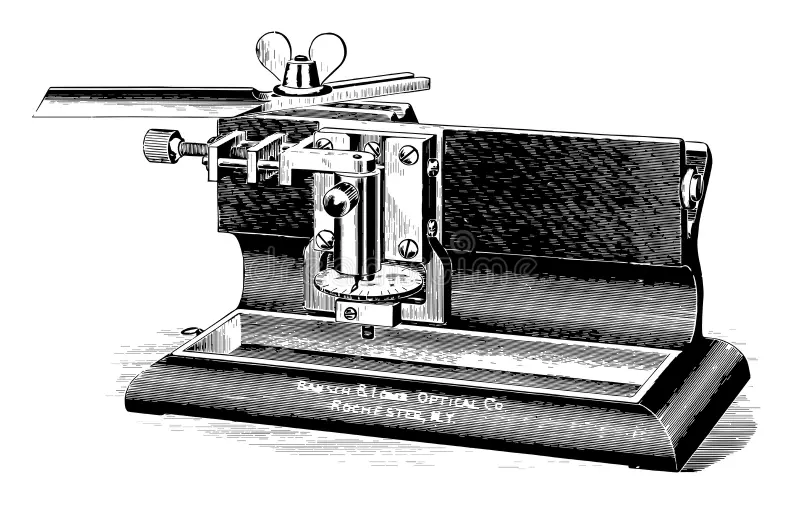
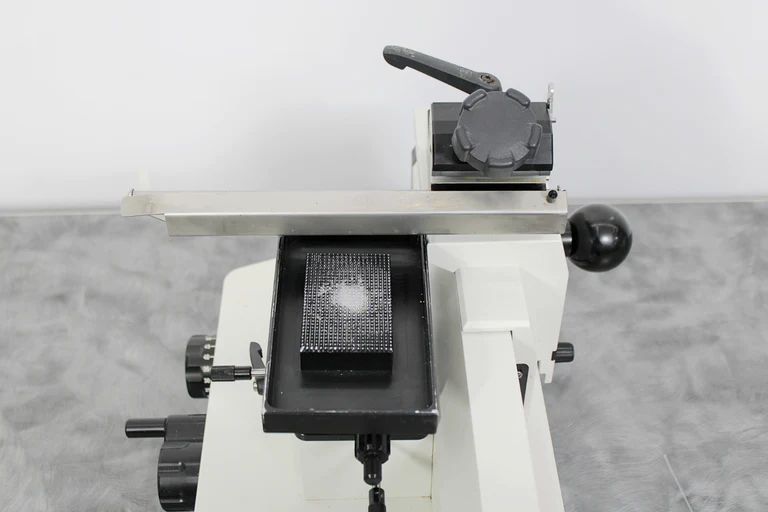
Figure 1. Left: A vintage illustration detailing the design of a classic sliding microtome, showing its fundamental structure and manual operation mechanism. Right: A modern photograph of a sliding microtome in action, highlighting the precision blade assembly used for sectioning samples, illustrating both the instrument’s continued functionality and its historical significance in tissue sectioning.
The Evolution to Modern Instruments: Vibratomes and Cryostats
With the advent of newer technologies, sliding microtomes have largely been replaced by more sophisticated instruments.
Precisionary Instruments’ Compresstome® vibratome, for instance, utilizes a vibrating blade that significantly reduces tissue compression. This ensures that even soft or live tissues, such as brain or organ samples, are sectioned with minimal deformation and far greater accuracy. The vibrating mechanism also allows for highly consistent section thickness—a crucial factor for sensitive applications such as electrophysiology and histopathology.
Cryostats represent another key advancement. They are designed specifically for sectioning frozen tissues, a strict requirement in many clinical and research settings. Cryostats enable the rapid preparation of tissue sections for immunohistochemistry or intraoperative consultations while maintaining the structural integrity of frozen specimens.
The automation, control, and precision offered by these modern instruments far surpass the outdated capabilities of sliding microtomes, making them indispensable tools in today’s laboratories. Transitioning to advanced vibratomes and cryostats not only improves the quality of tissue sections but also streamlines the overall workflow, allowing researchers to focus more on data analysis rather than manual sample preparation.
Upgrade Your Lab: Trade in Your Sliding Microtome
If your laboratory is still relying on older sliding microtomes, it may be time to consider upgrading to a modern vibratome system. Precisionary Instruments offers a unique trade-in program that allows labs to exchange outdated equipment for cutting-edge solutions. Embrace the future of tissue sectioning with instruments specifically designed to meet the evolving needs of modern research and clinical applications.