

Introducing the Levinger Lab and PhD Candidate Heidi Kreckel
At Colorado State University, the Levinger Lab—led by Professor Nancy E. Levinger—has long been a pioneer in exploring how molecules behave in nanoconfined environments. Recently, the Levinger group has added studies exploring how plant material can withstand cryoprotectant treatments that help it survive at ultralow temperatures.
One of the lab’s standout researchers is PhD candidate Heidi Kreckel, who brings a background in biochemistry and mathematics to her interdisciplinary research. Raised in Plattsburgh, NY, Kreckel earned dual degrees from SUNY Potsdam and gained early research experience working on fluorescent probe design and iron-binding protein analysis. Now at CSU, her focus is on understanding how cryoprotectants such as DMSO and glycerol behave inside live peppermint shoot tips—a key model system for advancing plant cryopreservation.
Significance: Cryopreservation Through the Lens of Coherent Raman Microscopy
Cryopreservation plays a critical role in agriculture, medicine, and conservation. Despite its widespread use, we still don’t fully understand how cryoprotectants interact with biological tissues, especially inplant systems. The Levinger Lab aims to uncover the fundamental chemistry that determines whether a preservation strategy will succeed—or fail.
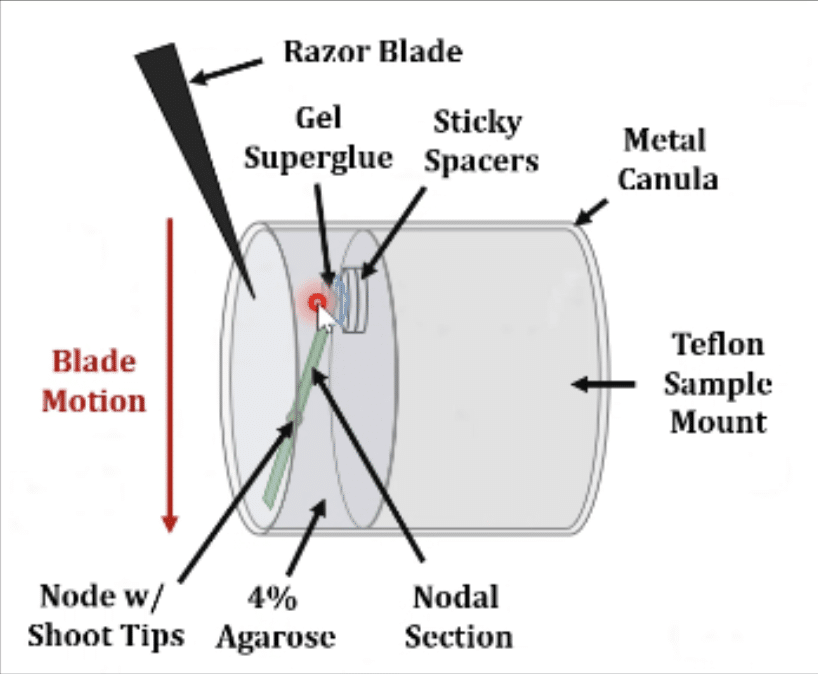
In her recent publication in Plant Cell, Tissue and Organ Culture, Kreckel developed a workflow to section live peppermint shoot tips, preserving their cellular architecture while preparing them for advanced optical imaging. Using coherent Raman microscopy, she tracks the movement of cryoprotectants into and through delicate plant tissue.
These insights are essential for developing predictive models of cryoprotection, especially for preserving diverse plant species that may not respond to existing protocols.
How the Compresstome® Vibratome Made It Possible
A major enabler of Kreckel’s research is the Compresstome® vibrating microtome. For her studies, Kreckel needed live, thin, and structurally intact sections of peppermint shoot tips to visualize cryoprotectant uptake without the use of fixatives or stains.
Using the Compresstome, she was able to:
- Generate 50 µm live tissue slices ideal for real-time imaging during exposure to cryoprotecting molecules
- Avoid tissue compression or tearing—common issues with traditional sectioning
- Preserve delicate shoot tip architecture for subcellular resolution
This level of consistency was vital to imaging experiments using coherent anti-Stokes Raman scattering (CARS) and fluorescence microscopy, both of which require exceptional sample quality.
📄 Download Heidi’s tip sheet on using sticky spacers for small samples

Looking Ahead
The Levinger Lab’s cryopreservation research is laying a foundation for improved preservation strategies in agriculture and conservation biology. Kreckel’s work exemplifies how combining chemical physics with biological modeling can unlock new answers about how cells survive extreme environments.
We’re proud that the Compresstome vibratome is part of the toolkit advancing this work. Researchers like Heidi Kreckel are not only pushing the boundaries of science—they’re helping build the next generation of tools to preserve life.
📬 Want to connect with scientists featured in our Lab Spotlights or learn more about live tissue sectioning for cryopreservation?
Contact us here—we’d be happy to help you get started.
#PCLS #precisioncutlungslices #vibratome #plantcryopreservation #Compresstome #LevingerLab #CSU #labspotlight #tissuesectioning #coherentRaman #liveimaging #plantbiology #cryoprotection #vibratingmicrotome