

Key Takeaways
- Synthetic cooling agents WS-3 and WS-23 — widely used as menthol substitutes in e-cigarettes — significantly enhance nicotine self-administration behavior in mice, matching the reinforcing effects of menthol itself.
- These coolants boost dopamine release in the nucleus accumbens core, increase the excitability of dopamine neurons in the ventral tegmental area, and amplify nicotine-induced upregulation of nicotinic acetylcholine receptors — all hallmarks of heightened addiction potential.
- Importantly, the cooling agents alone did not drive reinforcement or robust dopamine release; the enhancement depends on co-administration with nicotine, meaning these compounds specifically potentiate nicotine’s addictive properties.
- The Compresstome vibrating microtome was used to prepare 300 µm acute brain slices of the ventral tegmental area and nucleus accumbens core for fast-scan cyclic voltammetry and whole-cell patch-clamp electrophysiology experiments.
- These findings carry immediate regulatory implications, as WS-3 and WS-23 remain unregulated in electronic nicotine delivery systems despite functioning as pharmacologically active enhancers of nicotine dependence.
As bans on menthol in tobacco and nicotine products gain traction across states and municipalities, the e-cigarette industry has pivoted to synthetic cooling agents — compounds like WS-3 and WS-23 that replicate the cooling sensation of menthol without technically being menthol. But are these substitutes truly pharmacologically inert flavor additives, or do they carry the same risks that prompted regulators to target menthol in the first place? A new study published in Neuropsychopharmacology by Maddox et al. (2026) delivers a resounding answer: WS-3 and WS-23 actively enhance nicotine’s reinforcing and neurobiological effects, matching menthol in their capacity to deepen nicotine dependence. Led by Brandon J. Henderson’s laboratory, this work combines behavioral self-administration assays with cutting-edge neurophysiology and imaging techniques to build a comprehensive case that these unregulated compounds demand serious regulatory scrutiny. Dr. Henderson is no stranger to Precisionary: he previously joined us for a webinar on e-cigarette flavors’ effect on dopamine neuron function (browse our full webinar library), and this new study builds directly on that earlier work.
The Menthol Loophole: Why Substitute Coolants Matter
Menthol has long been recognized as more than just a flavor. Decades of research have established that menthol enhances nicotine reinforcement, increases dopamine signaling in reward circuits, and contributes to higher rates of nicotine dependence — particularly in vulnerable populations. These findings have driven policy efforts to ban menthol from cigarettes and flavored nicotine products. However, the regulatory landscape has not kept pace with industry innovation. Manufacturers of electronic nicotine delivery systems (ENDS) have increasingly turned to synthetic cooling agents such as WS-3 and WS-23 as menthol replacements. These compounds activate cold-sensing TRPM8 receptors to produce a familiar cooling sensation, but because they are chemically distinct from menthol, they fall outside existing or proposed menthol bans. Until now, virtually no preclinical data existed on whether these widely used substitutes share menthol’s ability to potentiate nicotine addiction. The Henderson laboratory set out to fill that critical knowledge gap.
Coolants Drive Mice to Self-Administer More Nicotine
Using an E-Vape self-administration (EVSA) paradigm — a behavioral model that closely mimics voluntary human vaping — the researchers exposed male and female C57BL/6J mice to nicotine vapor alone, nicotine combined with WS-3 and WS-23, nicotine combined with menthol, or a vehicle control (propylene glycol/vegetable glycerin, PGVG). The results were striking:
- Mice exposed to nicotine plus WS-3/WS-23 made significantly more active nosepokes and earned significantly more e-vape deliveries than mice receiving nicotine alone or PGVG control, in both males and females.
- The magnitude of this behavioral enhancement was comparable to that observed with menthol — meaning these synthetic substitutes are not weaker alternatives but pharmacological equals in driving nicotine-seeking behavior.
- Crucially, coolants administered without nicotine did not produce reinforcement behavior or robust dopamine release, demonstrating that WS-3 and WS-23 are not independently rewarding but instead specifically amplify nicotine’s addictive properties.
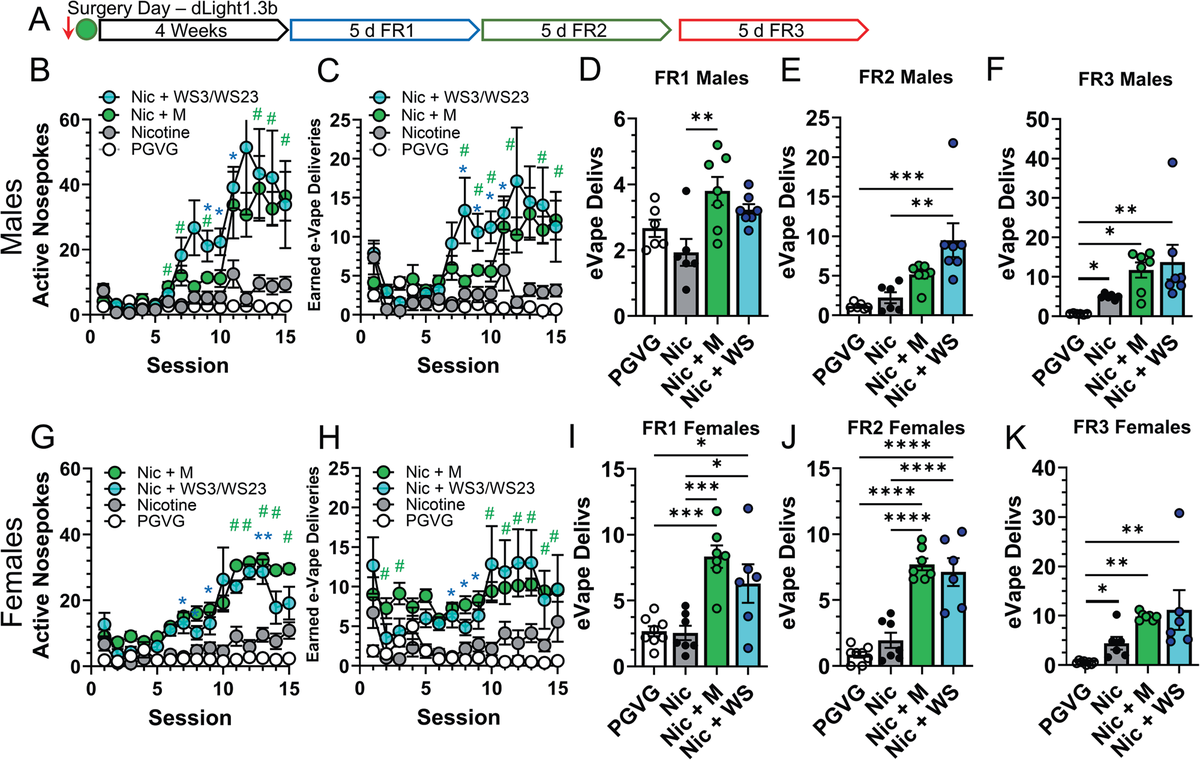
Figure 1. Mice self-administered more nicotine vapor when synthetic cooling agents (WS-3/WS-23) or menthol were added, taking more active nosepokes and earning more vapor deliveries than with nicotine alone—an effect seen in both male and female mice.
This last point is particularly important. It indicates that synthetic coolants do not simply provide a pleasant sensation that co-exists with nicotine use; rather, they interact with nicotine’s pharmacology to increase the drug’s hold on reward circuitry.
Rewiring the Reward Circuit: Dopamine Signaling, Neuron Excitability, and Receptor Upregulation
To understand the neurobiological mechanisms behind the behavioral effects, the team conducted a rigorous, multi-technique investigation of the mesolimbic dopamine system — the brain’s core reward pathway connecting the ventral tegmental area (VTA) to the nucleus accumbens (NAc) core.
Fiber photometry using the dLight1.3b dopamine sensor allowed the researchers to measure real-time dopamine dynamics in the NAc core of freely behaving mice during EVSA sessions. They found that WS-3 and WS-23 enhanced both cue-stimulated and eVape-stimulated dopamine signals relative to nicotine alone. This means the coolants amplified dopamine release not only in response to nicotine vapor itself but also in response to environmental cues predicting its delivery — a hallmark of addictive learning.
Fast-scan cyclic voltammetry (FSCV) in acute brain slices provided a more mechanistic view. Electrically evoked dopamine release in the NAc core was significantly greater in slices from mice that had self-administered nicotine with WS-3/WS-23, under both tonic (5 Hz) and phasic (60 Hz) stimulation conditions. These enhancements exceeded nicotine-alone levels and were comparable to or even greater than those seen with menthol.
Whole-cell patch-clamp electrophysiology revealed that synthetic coolants altered the intrinsic properties of VTA dopamine neurons. Neurons from coolant-exposed mice exhibited a reduced rheobase (the minimum current required to fire an action potential) and an increased maximal firing frequency, indicating that these neurons had become more excitable. Interestingly, the acute response to nicotine application during recordings was similar across groups, suggesting that the coolants’ effects operate through longer-term plasticity mechanisms rather than acute pharmacological synergy at the moment of nicotine exposure.
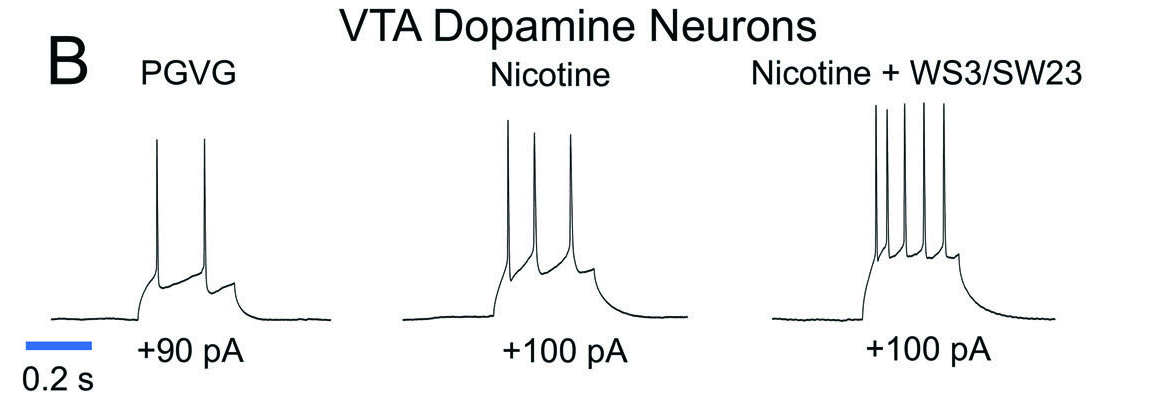
Figure 4B. Representative current-clamp recordings from VTA dopamine neurons showing increased firing with nicotine plus WS-3/WS-23 compared to nicotine alone or PGVG control.
Finally, using confocal microscopy with transgenic α6-GFP and α4-mCherry/α6-GFP reporter mice combined with pixel-based FRET (NFRET) analysis, the researchers examined nicotinic acetylcholine receptor (nAChR) populations on VTA dopamine neurons. WS-3 and WS-23 significantly enhanced nicotine-induced upregulation of both α4* and α6* nAChR subtypes. This receptor upregulation is a well-characterized neuroadaptation associated with chronic nicotine exposure and is thought to contribute to tolerance and dependence. Notably, no significant changes were observed in α4α6* heteromeric receptor density, suggesting subtype-specific effects that will warrant further investigation.
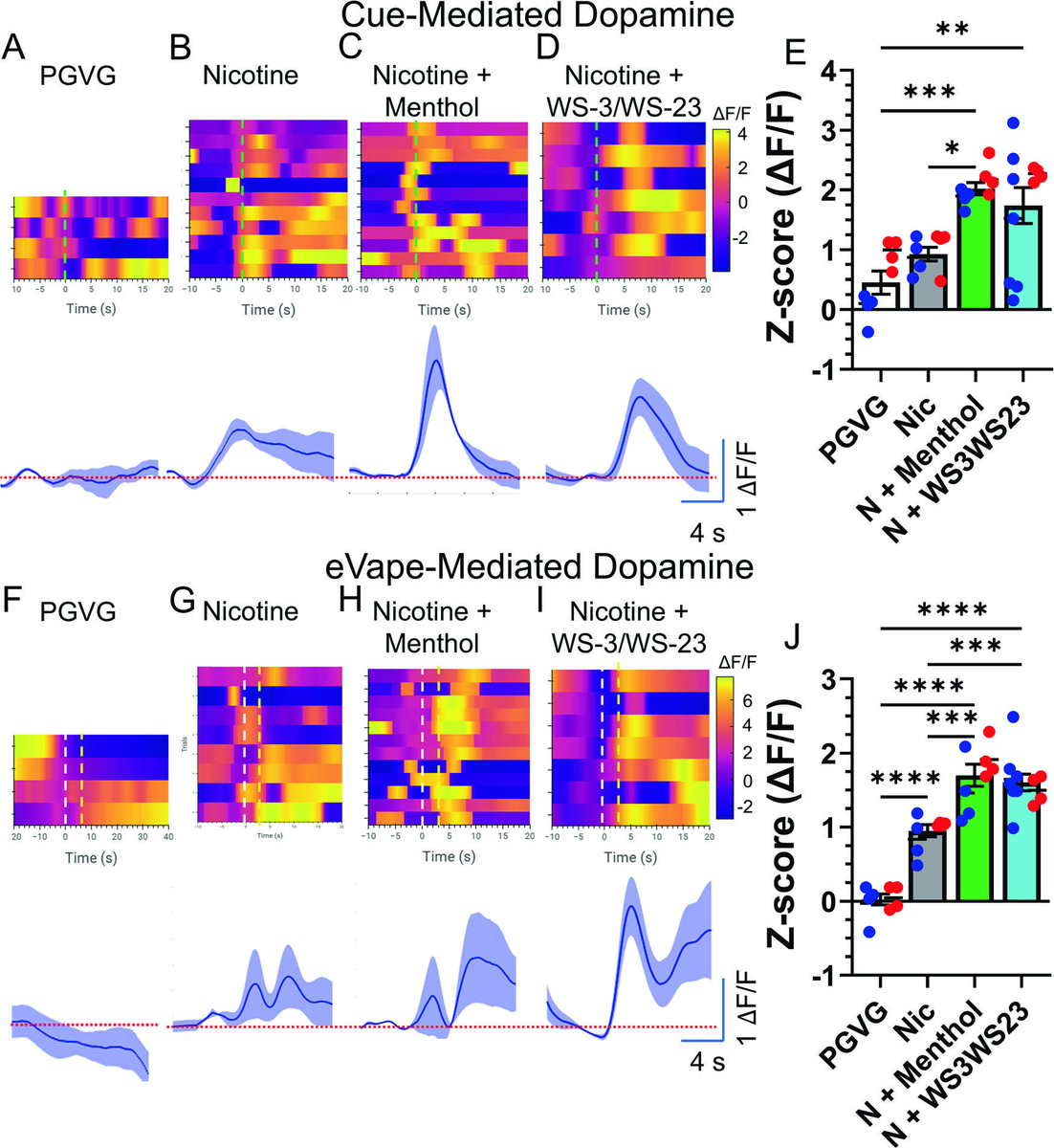
Figure 2. Real-time brain imaging shows that adding cooling agents to nicotine boosts dopamine release in the reward center of the brain, both when mice see a cue and when they actually receive a nicotine vapor puff.
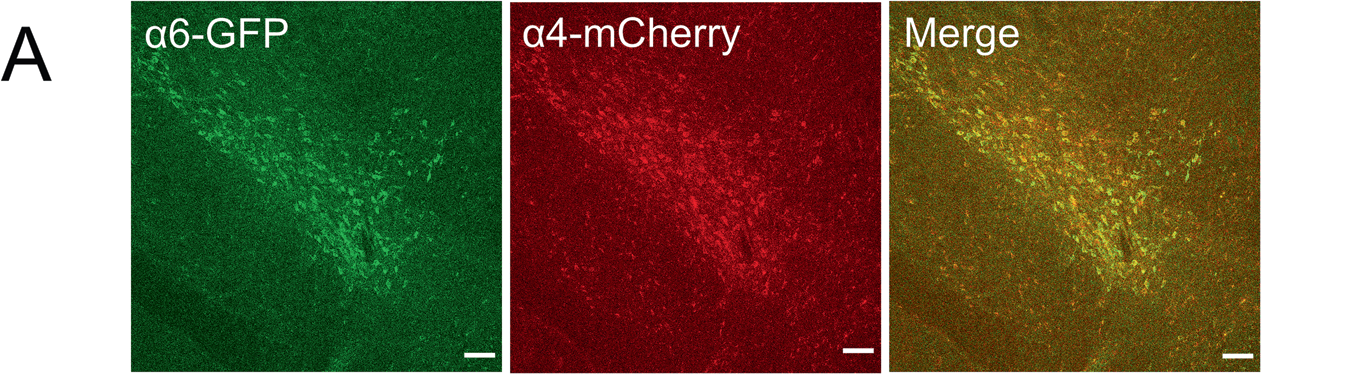
Figure 5A. Representative confocal images of α6-GFP, α4-mCherry, and merged nAChR fluorescence in VTA dopamine neurons.
Precision Brain Slices Enabling High-Fidelity Neurophysiology
The electrophysiology and voltammetry experiments in this study demanded exceptionally high-quality acute brain slices. Both FSCV in the NAc core and whole-cell patch-clamp recordings in the VTA require intact, healthy neural circuits with preserved synaptic connections and viable neurons — any tissue compression, tearing, or surface damage during sectioning can compromise dopamine terminal integrity and reduce the number of patchable neurons, undermining both data quality and throughput.
The Henderson laboratory used a Compresstome VF-300-0Z vibrating microtome to prepare 300 µm coronal brain slices from mouse tissue.
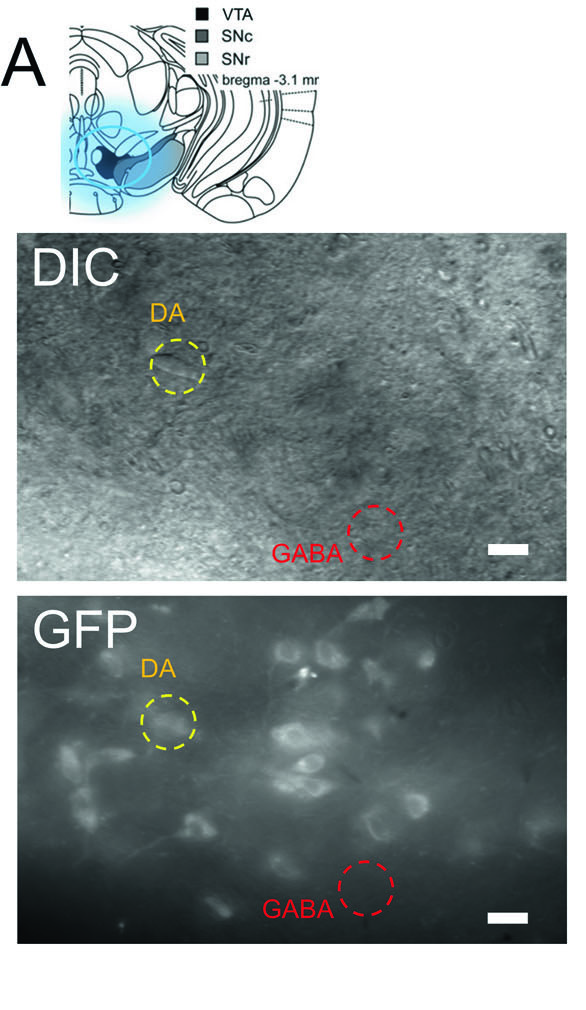
Figure 4A. Representative DIC and GFP images identifying VTA dopamine (DA) and GABA neurons in acute brain slices prepared with the Compresstome.
The Compresstome‘s agarose-compression technology was well suited to this application: by stabilizing the brain within an agarose block during sectioning, the system minimizes the lateral deflection and mechanical trauma that traditional vibratomes can inflict on soft neural tissue. For the VTA and NAc core — small, deep brain structures where even minor tissue distortion can shift the recording site away from the target region — this stabilization is not a luxury but a practical necessity. The resulting slices maintained the cellular health and circuit integrity needed for the study’s demanding multimodal experiments, from detecting sub-second dopamine transients via FSCV to achieving stable gigaohm seals for patch-clamp recordings of individual dopamine and GABA neurons.
An Urgent Signal for Regulators and the Field
The implications of this work extend well beyond the laboratory bench. WS-3 and WS-23 are currently present in a wide range of commercially available ENDS products, yet they remain entirely unregulated. The data presented by Maddox et al. demonstrate that these compounds are not pharmacologically inert — they actively potentiate nicotine reinforcement, reshape dopamine signaling in the brain’s reward circuitry, increase the excitability of dopamine neurons, and amplify the receptor-level neuroadaptations that drive nicotine dependence. In every metric examined, their effects matched or rivaled those of menthol, the very additive that regulators have identified as a public health priority to restrict.
This study also raises important questions for future research. Do different synthetic coolants vary in their potency? Are there sex-dependent differences in receptor upregulation patterns? How do these neuroadaptations develop over time, and are they reversible upon cessation? The Henderson laboratory’s multi-technique framework — combining voluntary self-administration with in vivo photometry, ex vivo voltammetry, electrophysiology, and receptor imaging — provides a powerful template for answering these questions.
We at Precisionary Instruments are proud that the Compresstome played a role in enabling this important research. If your laboratory is studying the neurobiology of addiction, mesolimbic dopamine signaling, or the impact of inhaled substances on brain circuitry, we would love to hear from you. Reach out to our team to learn how precision tissue sectioning can support your electrophysiology, voltammetry, and imaging workflows.